Gift cards are one of the best revenue tools available to independent retailers and restaurant operators. They drive new customer acquisition, bring in cash before a product is ever sold, and keep loyal customers coming back. The Canadian gift card market is expected to grow from about $11 billion in 2023 to nearly $14 billion by 2028. South of the border, it's a similar story.
And because gift cards have become so valuable, fraud has followed. That's not a reason to avoid them. It's a reason to run your program smartly. The operators who understand where their exposure is are the ones who stay ahead of it.
The operators who understand where their exposure is are the ones who stay ahead of it.
The Case for Gift Cards
Before getting into risk, it's worth being clear on why gift cards are worth protecting in the first place.
Gift cards generate revenue at the point of purchase, before any product changes hands. A meaningful percentage of cards are never fully redeemed, which adds to the margin. Customers who redeem gift cards often spend beyond the card's value. And gift card buyers are typically introducing your business to someone new, which makes every card sold a low-cost acquisition channel.
For independent retailers and restaurant operators, a well-run gift card program is one of the few tools that simultaneously improves cash flow, drives new traffic, and rewards existing customers. That's the asset worth protecting.
Fraud Is Real, and It Targets Independents
Independent retailers and restaurant operators are a specific target within the gift card fraud landscape. Large chains have dedicated loss prevention teams, sophisticated point-of-sale monitoring, and the budget to invest in physical security upgrades. Most independent operations don't, and fraudsters know it.
What's changed in recent years isn't just the scale. It's the sophistication. What was once opportunistic is now organized. Fraud prevention researchers identified 8.9 million stolen retail gift cards and 7.5 million quick-service restaurant gift cards listed for sale on underground markets ahead of the 2025 holiday season. These aren't lone actors, they're networks running operations at scale.

The numbers back that up, with the Canadian Anti-Fraud Centre (CAFC) reporting that Canadians consumers lost over $6.8 million to gift card fraud in 2024, nearly double the $3.8 million reported in 2021. The Federal Trade Commission received more than 41,000 fraud reports in 2024 in the US, representing $212 million in losses involving gift cards and prepaid cards. Those numbers almost certainly undercount the real damage. The Retail Council of Canada estimates that only 5 to 10% of gift card fraud cases are ever reported to the CAFC.
The Tactics You Need to Recognize
Card draining is the most common physical attack on in-store gift cards. Fraudsters remove the scratch strip from a card's PIN, record the card number and PIN, then replace the strip. They monitor the card's balance remotely, and the moment a customer activates it, they drain the funds. The customer ends up with an empty card. You end up with the complaint and the refund dispute.
CBC's Go Public covered this in detail earlier this year. One Ontario shopper purchased a $50 gift card from a Shoppers Drug Mart location and discovered on Christmas that it had already been drained. Getting any resolution required bouncing between the issuer and the retailer with no clear answer. That scenario plays out at independent retail and restaurant locations across the country, and open card displays near store entrances, away from staff sightlines and camera coverage, make it easy for fraudsters to work quickly and walk out without triggering any concern.
Social engineering scams don't require physical access at all. Fraudsters impersonate government agencies, utility companies, or other organizations to pressure customers or employees into purchasing gift cards as payment. In 2023 and 2024, gift cards became the number one payment method requested in fraud scams targeting seniors in Canada, according to the CAFC.
Stolen credit card purchases involve stolen card data, often sourced overseas, funneled into digital wallets and used to buy gift cards in bulk. Those cards are then converted to goods or cash. For retailers, this creates chargeback exposure on top of inventory loss. It's a compounding hit that's especially hard for independent operators to absorb.
The reputational exposure compounds everything else. Even when you're not directly at fault, your store is where the customer bought the card. That's the detail they remember, and it's what they tell people.
What You Can Do Right Now
The good news is that meaningful protection doesn't require an enterprise budget or a dedicated loss prevention team. Smart operators treat the following as standard practice, and most of it costs nothing but attention.
Secure Your Physical Card Displays
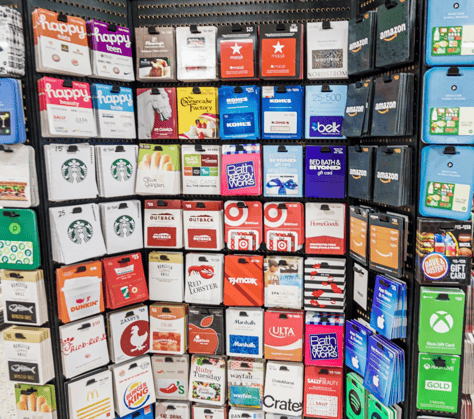
Open racks near store entrances are the primary enabler of card draining. Moving gift cards close to registers or behind the counter significantly raises the risk of detection for anyone attempting to tamper with them. It's a low-cost change with an immediate impact on your exposure.
Train Your Team to Spot Warning Signs
Your staff interact with customers at the point of purchase, which makes them your most useful early warning system. They can also be your best defense: 25% of consumers who purchased a gift card to pay a scammer were warned by a store clerk before the transaction completed.
The key is giving staff something concrete to look for. A newly activated card that shows no available balance is an immediate red flag. So is a customer insisting on paying exclusively with gift cards. And before any card leaves the display, staff should get in the habit of checking the packaging for signs of tampering. When they know what suspicious looks like, they're far more likely to catch it before the transaction completes.
Inspect Your Card Inventory Regularly
Tampering isn't always obvious, but it leaves traces. Check cards on the floor for loose packaging, scratched PINs, excess glue, or barcodes that look reprinted or layered. Building this into a weekly routine, and a daily one in the lead-up to peak gifting seasons, catches compromised cards before customers do.
Go Digital Where You Can
The most direct way to eliminate card draining risk is to remove the physical card from the equation. A digital gift card program has no rack to tamper with and no PIN strip to scratch off. Every transaction is tied to an account, every activation is logged, and unusual patterns are visible in real time. That visibility is what turns a fraud incident from a surprise into something you can catch early.
Set Limits on High-Volume Purchases
Bulk gift card purchases using stolen credit card data are a well-documented fraud pattern. Setting a per-transaction purchase limit, or requiring identification for high-value purchases, creates friction that deters this type of fraud without meaningfully affecting legitimate buyers.
Understand Your Chargeback Exposure
If a customer uses a stolen credit card to buy gift cards at your store, the chargeback typically arrives after the card balance has already been spent. Keeping a record of the payment method used for gift card purchases, and flagging patterns like repeated large purchases on new cards, gives you evidence for disputes and the visibility to catch the pattern earlier.
Conclusion: The Operators Who Run Gift Card Programs Well Aren't Avoiding Risk. They're Managing It
Gift cards are a genuine revenue driver for independent retailers and restaurant operators, and they're going to stay that way. The fraud landscape has changed, but the response doesn't require an overhaul. Better display practices, a trained team, and a program with transaction-level visibility can dramatically reduce your exposure.
The operators who do this well aren't running perfect programs, they're running informed ones. They know what's moving through their system, they've built habits around physical security, and they've chosen platforms that give them the visibility to catch problems before they become losses. That combination, not any single fix, is what separates a well-run gift card program from a vulnerable one.
Browse our gift card and loyalty resources for operators.
.png)