What can your business learn from the loyalty programs behind some of the biggest brands? In our Anatomy of a Loyalty Program series, we take a closer look at what different brands are getting right, where there's room for improvement, and the ideas you can apply to your own loyalty strategy.
For transparency, Starbucks is not a DataCandy client. We're looking at its loyalty program independently to unpack what restaurants and other businesses can learn from its approach.
Starbucks has built one of the most recognizable loyalty programs in the world. What started as a simple way to reward customers for buying coffee has evolved into a sophisticated ecosystem built around personalization, mobile engagement, customer data, and increasingly valuable rewards.
And the numbers make it clear that loyalty is more than a nice perk for Starbucks. It is a significant part of the company's business. With more than 35 million active Starbucks Rewards members in the U.S. alone, loyalty customers play a major role in driving sales and repeat visits. But Starbucks' success isn't simply because it has a lot of members. The company continually changes its program to reflect customer behavior and feedback.
For restaurants and other businesses, that's the bigger lesson: a loyalty program shouldn't be something you launch once and leave alone. It should be an evolving tool for building stronger customer relationships and driving repeat business.
How Does the Starbucks Loyalty Program Work?
At its core, Starbucks Rewards is a simple earn-and-redeem loyalty program. Members earn Stars when they make purchases through Starbucks, then use those Stars to get rewards such as discounts on purchases, food, and drinks.
The program is built into the Starbucks mobile app, so customers can do almost everything in one place: order ahead, pay, earn Stars, see their progress, and redeem rewards. This makes loyalty part of the regular Starbucks experience rather than something customers have to think about separately.
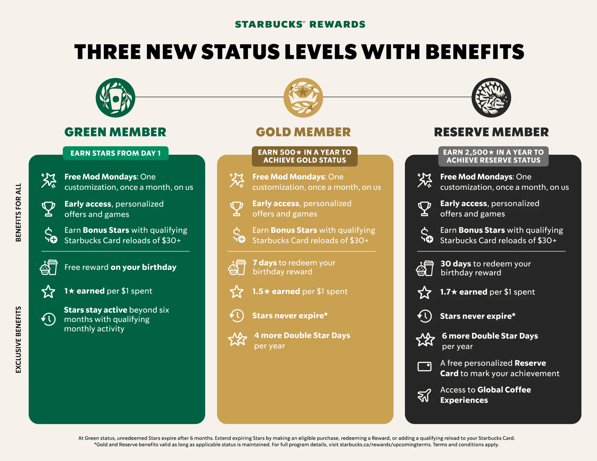
In March 2026, Starbucks took its loyalty program a step further by introducing three membership tiers: Green, Gold, and Reserve. Each tier offers increasing benefits and faster Star earning, giving customers an incentive to engage more frequently with the brand.
-
Green: The entry-level tier gives members access to Rewards and lets them keep their Stars from expiring as long as they remain active each month.
-
Gold: Gold members unlock additional benefits and faster Star earning, along with Stars that never expire.
-
Reserve: The highest tier offers Starbucks' most elevated benefits and the fastest path to earning Stars, with Stars that never expire.
The new structure represents a shift from Starbucks' previous model, where Star earning was tied largely to how customers paid. Now, the more engaged a customer becomes, the faster they can earn and the more valuable their benefits become.
That's an important distinction. Starbucks isn't simply giving customers more discounts. It's using its loyalty program to encourage the behaviors it wants to see more of: frequent visits, continued engagement, and deeper relationships with the brand.
The Numbers Speak for Themselves
Starbucks' loyalty program has become a major part of how the company drives repeat visits, engagement, and sales. And the scale of that impact is hard to ignore.
With millions of customers actively engaging with Starbucks Rewards, the program gives the company an enormous amount of insight into customer behavior while giving members a reason to keep coming back.
Here are a few numbers that show just how much loyalty contributes to the business:
- 35.5 million active members: Starbucks Rewards has 35.5 million active members in the U.S. alone.
- 44% customer retention: Starbucks has a 44% customer retention rate, compared with an industry average of 25%.
- 3x more spending: Starbucks loyalty members spend roughly three times more than non-members.
- 41% of U.S. sales: Rewards members account for 41% of Starbucks' U.S. sales.
- Increased visit frequency: 71% of Starbucks app users visit a Starbucks location at least once a week.
These numbers aren't just evidence that people like free coffee. They show what can happen when a loyalty program becomes part of the way a business drives customer behavior. More members means more opportunities to understand customers. More data means more opportunities to personalize offers. And more engagement gives Starbucks more chances to turn an occasional visit into a habit.
That's what makes loyalty so valuable. Done well, it's not simply a discount program. It's a customer retention and engagement strategy.
What Starbucks Gets Right About Loyalty (and What Your Business Can Learn)
Starbucks' loyalty program isn't successful because it has the most complicated technology or the most rewards. Its strength comes from continually asking a simple question: What will make customers want to come back?
Here are some of the biggest things Starbucks gets right.
1. Keep Evolving Your Loyalty Program
Starbucks' latest Rewards changes highlight a simple lesson: your loyalty program shouldn't be set in stone. And the changes appear to be working. The redesigned program helped lift 90-day active Starbucks Rewards membership to a record 35.6 million, up 4% year over year.
Customer preferences change, purchasing habits shift, and what motivates customers today may not have the same impact a year from now. Starbucks responded to this by redesigning its program around how its customers were already engaging with the brand, introducing new membership tiers, faster ways to earn Stars, and new rewards that give customers more value as their activity increases.
Use your loyalty data to identify how often customers visit, what they buy, how much they spend, and which rewards they actually use. Then use those insights to adjust your program.
That could mean introducing a new reward, testing a limited-time offer, changing how customers earn points, or adding a benefit members have been asking for.
The key is to have a clear goal behind each change. Are you trying to increase visit frequency? Encourage customers to try a new product? Drive traffic during slower periods? Increase average order value?
2. Make Rewards Easy to Understand and Redeem
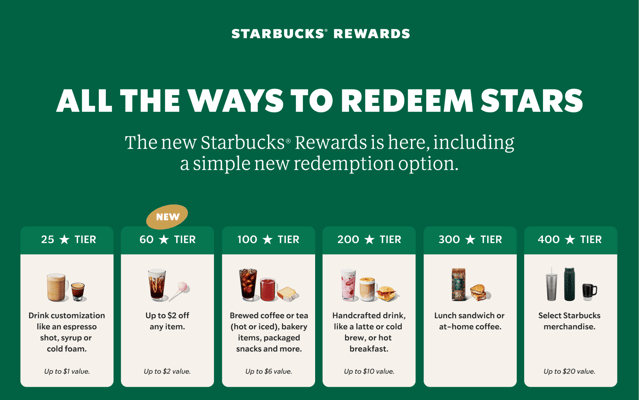
When it comes to loyalty programs, a simple reward can go a long way. When Starbucks introduced a new 60-Star redemption option worth $2 off, it quickly became its most popular reward, accounting for roughly one-third of all redemptions.
Customers don't want to do mental gymnastics to figure out whether they've earned a reward. They want to know: How do I earn it? What do I get? How close am I? The easier those answers are to understand, the more likely customers are to engage.
3. Reward Increased Engagement With Increased Value
Starbucks' new tiered structure also demonstrates another important loyalty principle: give your best customers a reason to keep going. Each tier offers faster Star earning and enhanced Rewards, meaning customers receive more value as their engagement increases. This creates a natural incentive to move from being an occasional customer to a regular customer.
For restaurants, this could mean offering benefits such as:
-
A birthday reward for all members
-
A free item after a certain number of visits
-
Exclusive offers for frequent customers
-
Bonus points during slower periods
-
VIP rewards for your highest-value customers
The goal isn't necessarily to offer bigger discounts. It's to make increased loyalty feel worthwhile.
4. Build a Mobile-First Loyalty Experience
71% of Starbucks app users visit a store at least once a week, demonstrating how powerful an accessible digital connection can be.
A loyalty program that lives on a customer's phone is always within reach. Customers can see their rewards, place orders, pay, and interact with the brand without having to remember a physical card or manually track points. For businesses looking to build a similar experience, a loyalty mobile app can make it easier for customers to stay connected to your program and engage with it regularly.
Digital loyalty can help customers:
-
Check their points or rewards
-
Receive personalized offers
-
Earn and redeem rewards without carrying a physical card
-
Get reminders and updates
-
Stay connected with your business between visits
There's another benefit, too: mobile creates more opportunities for timely engagement. Starbucks has used location-based marketing to send relevant messages to customers based on where they are, helping bring customers into nearby stores.
For other businesses, the lesson isn't necessarily to recreate the Starbucks app. It's to make your loyalty program as accessible as possible and meet customers where they already are.
5. Ultra Personalization
One of the biggest advantages of a loyalty program is the customer data it generates. Every purchase can tell you something about your customers: what they buy, how often they visit, how much they spend, and when they're most likely to return.
Starbucks puts that information to work across its loyalty and mobile experience. Members can receive personalized offers, reminders, and updates directly through the app. As mentioned above, Starbucks also uses location-based marketing to send relevant messages based on where customers are, helping encourage visits to nearby stores.
This is where having a digital loyalty program becomes especially useful. Instead of waiting for a customer to walk through the door, businesses can use what they know about that customer to reach them at the right time, with something that's actually relevant to them.
And personalization doesn't have to mean creating a completely different offer for every customer. It could be as simple as:
- Sending a coffee offer to a customer who regularly buys coffee but hasn't visited recently.
- Giving a frequent lunch customer a bonus for visiting during a slower period.
- Promoting a product a customer regularly orders instead of sending a generic promotion.
- Offering an exclusive perk to your highest-value customers.
- Sending a reminder when a customer is approaching a reward or has enough points to redeem one.
Starbucks' approach shows how loyalty, customer data, and mobile can work together. The more you understand how customers interact with your business, the more relevant you can make the experience, and the more reasons you can give them to come back.
Where Starbucks' Loyalty Strategy Could Improve
Even a successful loyalty program isn't going to get everything right. Starbucks' 2026 Rewards overhaul shows how changing a loyalty program can create friction when customers have a different understanding of their status than the business does.
With the new tiered structure, higher-status members earn Stars faster, unlock additional benefits, and have more flexibility around Star expiration. The birthday reward is one example. Green members can redeem their treat on their actual birthday, Gold members get a seven-day window, and Reserve members have 30 days to use theirs.
The structure itself gives customers a clear reason to engage more with the brand. But the return of the Gold name created an unexpected issue for some longtime members.
Before the 2026 overhaul, Starbucks had eliminated its tiered structure in 2019. However, some customers continued using their old Gold Cards, which remained part of their Starbucks experience. When the new program launched and those customers were placed in the Green tier based on their recent activity, some interpreted the change as losing a status they believed they still had.
Importantly, Green members weren't necessarily losing the benefits they had under the previous flat program. The problem was the perception of the change. Customers weren't just seeing a new loyalty structure. Some felt like something they had earned or identified with had been taken away.
That's an important loyalty lesson: when a loyalty program changes, customers naturally compare it to what they had before.
If you're making changes to an existing loyalty program, think beyond the new rewards and earning structure. Consider what existing members believe they have, what they've become accustomed to, and what the change might look like from their perspective.
A few things can help make that transition smoother:
-
Explain what's changing and why: Give customers context instead of simply announcing new rules.
-
Address old benefits and terminology: If you're bringing back, retiring, or redefining a familiar feature, make that history clear.
-
Be clear about what customers are keeping: Show members how their existing rewards or benefits carry over.
-
Lead with the value: Make it easy for customers to understand what they can gain from the new program.
-
Listen to the response: Customer questions and feedback can reveal where a change is creating confusion or a sense of loss.
The lesson isn't that loyalty programs shouldn't evolve. It's that the transition matters, too. A program can be thoughtfully designed and still create frustration if customers don't understand how the changes affect them or why they're happening.
The Starbucks Lesson: Loyalty Is an Ongoing Strategy
Starbucks gets a lot right about loyalty, but perhaps its biggest lesson is that loyalty isn't a program you set and forget.
Its Rewards program has evolved alongside customer expectations, technology, and purchasing behavior. The latest changes put even more emphasis on personalization, recognition, and meaningful benefits rather than simply offering bigger discounts.
For restaurants and retailers, you don't need 35 million members or a Starbucks-sized app to apply the same principles. You need a loyalty program that makes customers want to come back, gives you useful insight into their behavior, and lets you turn that insight into more relevant experiences.
Explore DataCandy's loyalty solution and see how you can turn customer data into more repeat visits, engagement, and sales.